
–
–
La Doctrina de la Confianza Soberana (DCS) es una propuesta política en construcción que parte de una idea simple y decisiva: ninguna sociedad puede sostenerse sobre la sospecha permanente de sus propios trabajadores y ciudadanos.
El control sin sentido erosiona derechos, debilita la comunidad y termina afectando al propio Estado. Frente a ello, la confianza no es ingenuidad: es un acto político soberano, capaz de reconstruir la legitimidad y devolver dignidad al vínculo social.
De la sospecha al control
Durante décadas, el Estado argentino desarrolló una forma de gobierno basada en la desconfianza. Primero sobre policías y penitenciarios; luego sobre otros trabajadores estatales; y finalmente sobre la sociedad en su conjunto.
Esta Doctrina de la Sospecha Permanente se expresa en:
- castigos anticipados
- controles abusivos
- sanciones sin debido proceso
- vigilancia que debilita la ciudadanía
El resultado es un Estado que, en lugar de garantizar seguridad y justicia, produce incertidumbre y desprotección.
La confianza como soberanía
La Confianza Soberana propone un cambio de paradigma: reconstruir el vínculo entre Estado y sociedad a partir de la confianza mutua.
- Confiar en el trabajador implica reconocerlo como sujeto de derechos.
- Confiar en el ciudadano significa ampliar sus libertades, no restringirlas.
- Confiar en las instituciones supone devolverles legitimidad y capacidad de servicio.
Lejos de ser un gesto ingenuo, la confianza es un acto soberano: es el pueblo, organizado y consciente, el que decide dejar de gobernar desde el miedo para hacerlo desde la dignidad y el bien común.
Una arquitectura distinta del poder
La Confianza Soberana no es solo un principio ético, sino una propuesta de reorganización institucional.
Implica pasar de un Estado que controla preventivamente a uno que se legitima en el acuerdo con sus trabajadores y ciudadanos.
Esto supone:
- garantías laborales efectivas para quienes integran la seguridad pública
- reconocimiento pleno de derechos políticos
- instituciones transparentes que generen confianza en lugar de desconfianza
En este sentido, la confianza no es un complemento: es el fundamento sobre el cual puede construirse un Estado justo, eficiente y soberano.
Síntesis
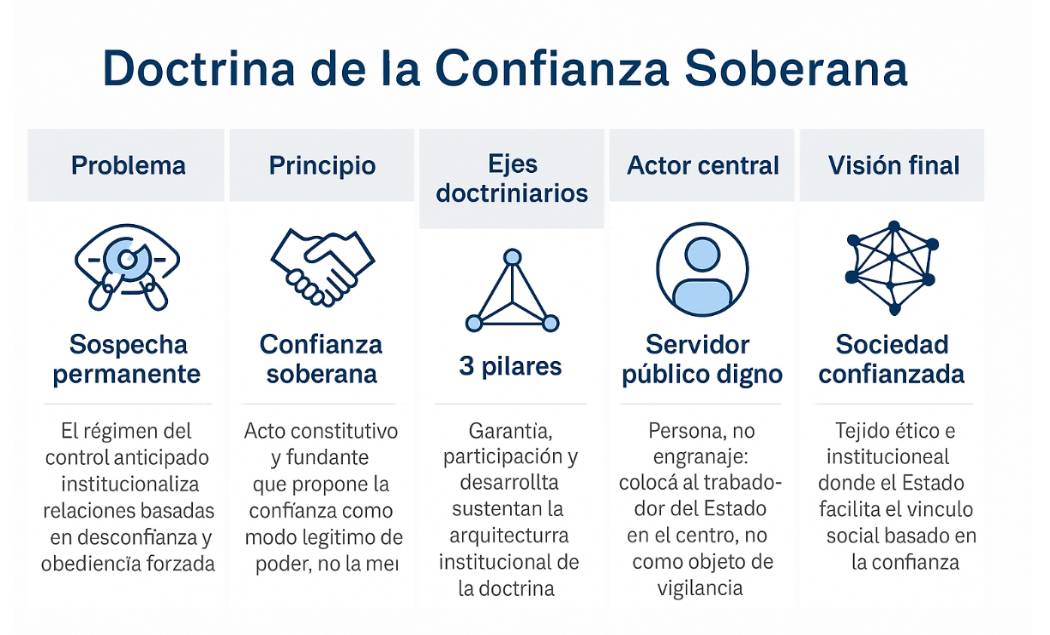
| Eje | Concepto clave | Descripción | Aporte |
|---|---|---|---|
| Problema | Sospecha permanente | Régimen de control anticipado | Institucionaliza relaciones basadas en desconfianza |
| Principio | Confianza soberana | Acto constitutivo | Define un modo legítimo de ejercicio del poder |
| Estructura | Tres pilares | Garantía, participación y desarrollo | Sustenta la arquitectura institucional |
| Actor | Servidor público | Persona, no engranaje | Centralidad del trabajador estatal |
| Resultado | Sociedad basada en confianza | Tejido ético e institucional | Reconfiguración del vínculo Estado-sociedad |
–
English Version Available Below
What is the Doctrine of Sovereign Trust (DST)?
–
–
The Doctrine of Sovereign Trust (DST) is an evolving political framework grounded in a simple yet decisive premise: no society can be sustained on the basis of permanent suspicion toward its own workers and citizens.
Control devoid of normative grounding erodes rights, weakens social cohesion, and ultimately undermines the State itself. In contrast, trust is not naïveté but a sovereign political act—capable of restoring legitimacy and reconstituting the dignity of the social bond.
From Suspicion to Control
Over recent decades, the Argentine State has developed forms of governance structured around distrust. Initially directed at police and penitentiary personnel, this logic has progressively extended to other public workers and, ultimately, to society as a whole.
This Doctrine of Permanent Suspicion manifests through:
- anticipatory punishment
- excessive or discretionary control
- sanctions without due process
- forms of surveillance that weaken citizenship
The result is a State that, rather than guaranteeing security and justice, produces uncertainty and institutional vulnerability.
Trust as Sovereignty
The Doctrine of Sovereign Trust proposes a paradigmatic shift: the reconstruction of the relationship between State and society on the basis of mutual trust.
- Trusting the public worker entails recognizing them as a subject of rights.
- Trusting the citizen implies expanding freedoms rather than restricting them.
- Trusting institutions requires restoring their legitimacy and public function.
Far from being a naïve stance, trust is conceived as a sovereign act: it is the organized and conscious political community that chooses to move beyond governance based on fear and toward a model grounded in dignity and the common good.
An Alternative Architecture of Power
Sovereign Trust is not merely an ethical principle but an alternative institutional framework.
It implies a transition from a State centered on preventive control to one legitimized through a normative pact with its workers and citizens.
This entails:
- effective labor guarantees for those serving in public security
- full recognition of political rights
- transparent institutions capable of generating trust rather than suspicion
In this sense, trust is not a supplementary value but the foundational principle upon which a just, efficient, and sovereign State can be constructed.
Synthesis
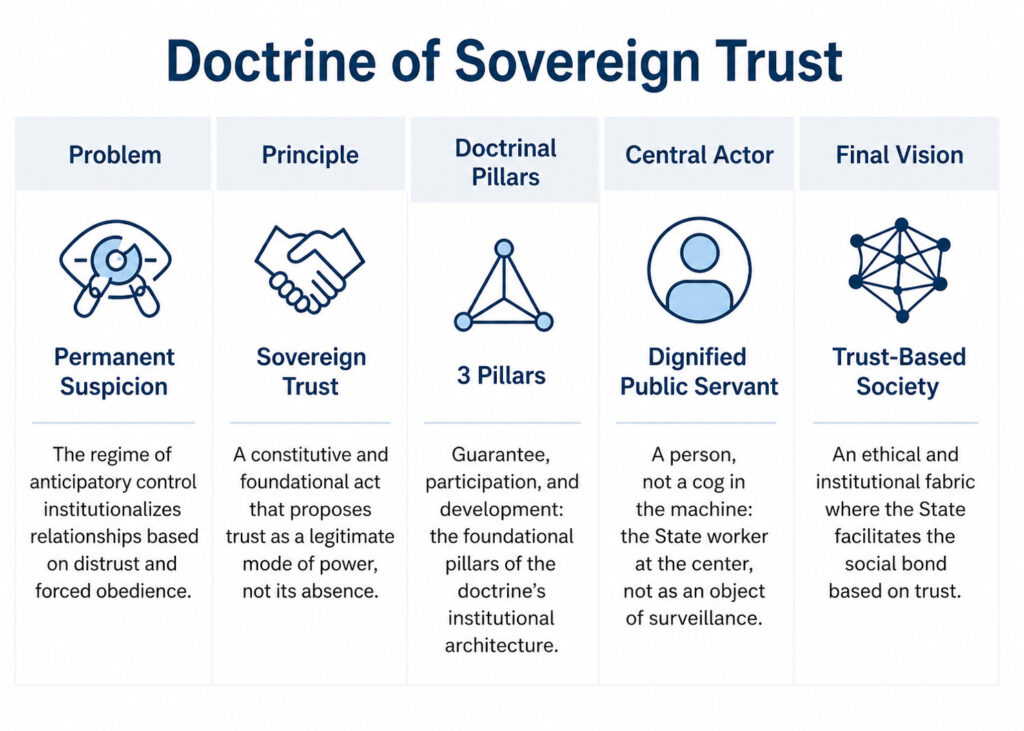
| Axis | Key Concept | Description | Contribution |
|---|---|---|---|
| Problem | Permanent Suspicion | Regime of anticipatory control | Institutionalizes distrust-based relations |
| Principle | Sovereign Trust | Foundational political act | Defines a legitimate mode of power |
| Structure | Three pillars | Guarantee, participation, development | Supports institutional architecture |
| Central Actor | Public servant | Person, not instrument | Re-centers the role of the State worker |
| Outcome | Trust-based society | Ethical and institutional fabric | Reconfigures the State–society relationship |