
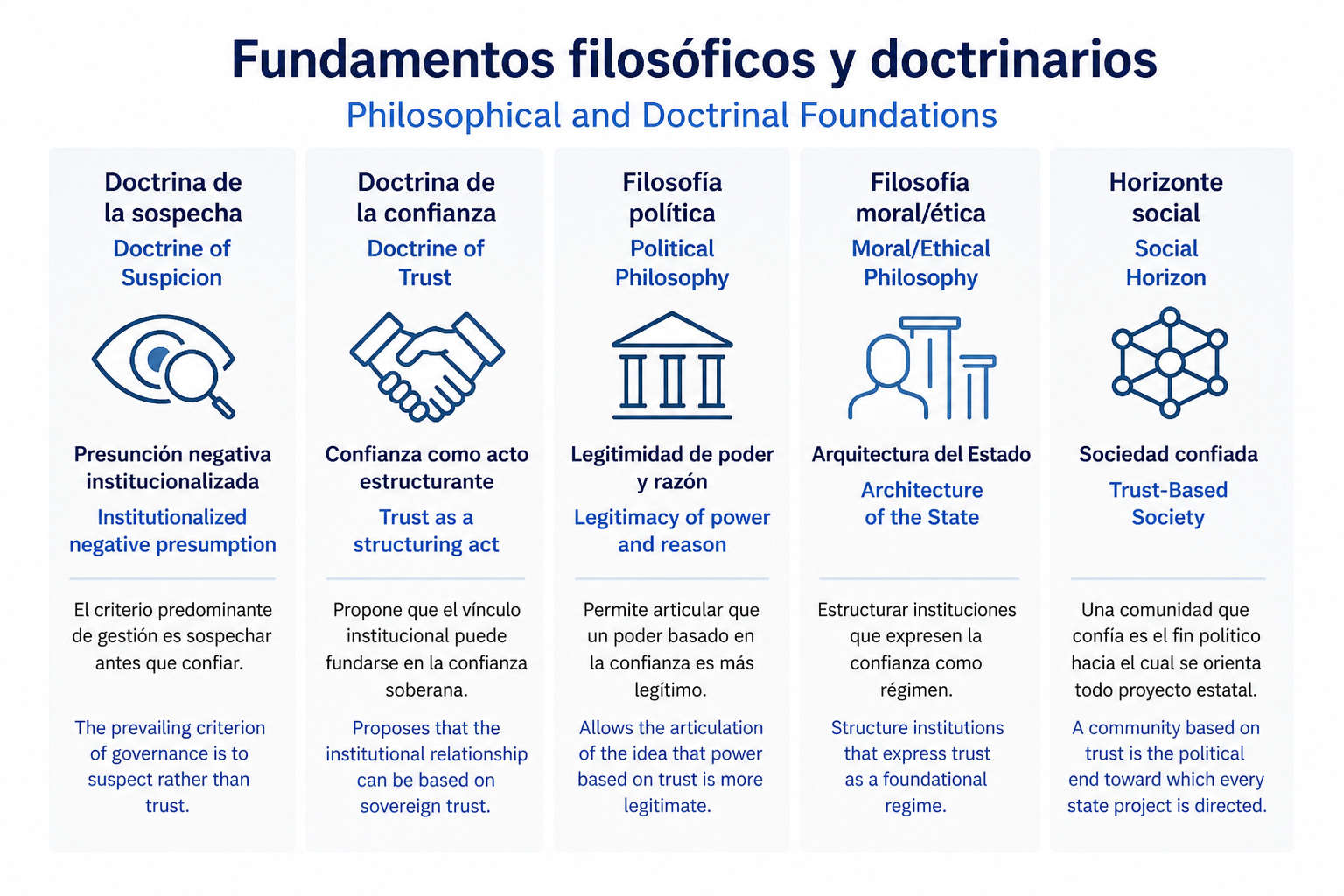
La Doctrina de la Confianza Soberana (DCS) se apoya en tradiciones filosóficas y políticas que ponen a la persona y a la comunidad en el centro. Desde MacIntyre y Mounier hasta Dussel y Buela, pasando por Foucault, Luhmann, Illich y el Papa Francisco, se dibuja un mismo horizonte: salir del miedo administrado por la sospecha y reconstruir la soberanía desde la confianza.
Una raíz que viene de lejos
La DCS no nace en el vacío: se apoya en corrientes que han buscado quebrar el gobierno del miedo y reconstruir la comunidad desde la dignidad del trabajador y la soberanía popular. En contraste, la Doctrina de la Sospecha Permanente (DSP) ordena el mundo a partir del control, la vigilancia y el castigo anticipado.
1) Ética de las virtudes y personalismo comunitario
-
Alasdair MacIntyre: las virtudes florecen en prácticas y comunidades; sin confianza, no hay proyecto común.
-
Emmanuel Mounier: el personalismo afirma a la persona en relación; la comunidad no es masa, es encuentro responsable.
-
San Alberto Hurtado: dignidad del trabajador y justicia social como núcleo de un Estado humano.
-
Papa Francisco: cultura del encuentro y rechazo de la lógica del descarte; la confianza como opción ética y política.
-
Ivan Illich: crítica a los sistemas que expropian la autonomía (educación, salud, burocracias).
-
Leonardo Castellani: alerta ante el Estado sin alma que reduce al servidor a engranaje.
Clave DCS: la confianza no es ingenuidad; es virtud cívica que sostiene instituciones sanas.
2) Poder, vigilancia y estado de excepción
-
Michel Foucault: genealogía del poder disciplinario y las racionalidades de gobierno.
-
Giorgio Agamben: estado de excepción como norma encubierta.
-
Hannah Arendt: libertad, juicio y responsabilidad frente a la banalidad del mal burocrático.
-
Carl Schmitt: la decisión soberana revela los límites del orden jurídico (a problematizar).
-
Byung-Chul Han: del disciplinamiento explícito a la autoexplotación y la vigilancia interiorizada.
Clave DCS: salir de la “normalidad” del control preventivo y reponer límites, garantías y sentido.
3) Confianza, capital social y gobernanza
-
Niklas Luhmann: la confianza reduce complejidad y hace posible la acción.
-
Robert Putnam: capital social y cooperación como condición de instituciones eficaces.
-
Diego Gambetta / Russell Hardin: confianza, reputación y razonabilidad en contextos de riesgo.
-
Elinor Ostrom: gobernanza policéntrica y reglas compartidas que construyen cooperación.
-
Pierre Rosanvallon / Tocqueville: contrapoderes, asociaciones y confianza democrática.
Clave DCS: la confianza es capital público que fortalece la legitimidad y mejora resultados.
4) Sociología crítica e instituciones
-
Pierre Bourdieu: habitus, campo y violencia simbólica en los dispositivos institucionales.
-
C. Wright Mills: imaginación sociológica para unir biografía y estructura.
-
Paul DiMaggio & Walter Powell: isomorfismo institucional y reproducción de rutinas de control.
-
Gino Germani: modernización, populismo y formas de integración (para debatir críticamente en clave local).
Clave DCS: entender cómo la sospecha se naturaliza como sentido común institucional.
5) Pensamiento nacional iberoamericano y latinoamericano
-
Enrique Dussel: ética de la liberación y crítica al poder que cosifica.
-
Alberto Buela Lamas: metapolítica, disenso y comunidad organizada iberoamericana.
-
Jorge Abelardo Ramos: nación y patria grande como horizonte de soberanía.
-
Arturo Jauretche / J. W. Cooke / Scalabrini Ortiz: crítica a la colonización cultural y defensa del pueblo organizado.
-
Juan D. Perón: La comunidad organizada como arquitectura de bien común.
-
Alejandro Álvarez: fideipolítica: el servidor público como sujeto de dignidad; confianza como principio de gobierno.
-
Hugo Chávez (fase doctrinaria): soberanía, organización popular y Estado al servicio del común.
Clave DCS: la confianza soberana como acto político que integra tradición, pueblo y futuro.
6) Derecho del trabajo, estándares y control legítimo
-
OIT – Convenios 87 y 98: libertad sindical y negociación colectiva.
-
CIDH (2009): Seguridad ciudadana, democracia y derechos humanos, límites a la militarización del control.
-
Estudios policiales comparados (Bayley, Bittner, Waddington, Janet Chan): control con garantías, profesionalización y comunidad.
Clave DCS: controles legítimos, con garantías, participación y transparencia; no castigo anticipado.
7) Fundamentos doctrinarios propios (síntesis)
-
La confianza es un acto político soberano.
-
La dignidad del trabajador funda la legitimidad estatal.
-
La sospecha permanente erosiona justicia y destruye comunidad.
-
La confianza es capital público que fortalece instituciones.
-
La soberanía se reconstruye desde abajo, en clave comunitaria.
-
El control legítimo requiere garantías, participación y transparencia.
-
La organización solidaria vence al miedo y repara el lazo social.
8) Para seguir pensando (lecturas clave)
-
MacIntyre, A. After Virtue.
-
Mounier, E. Manifiesto al servicio del personalismo.
-
Illich, I. La sociedad desescolarizada; Némesis médica.
-
Castellani, L. (ensayos y homilías sobre Estado y comunidad).
-
Francisco. Fratelli tutti; Evangelii Gaudium.
-
Foucault, M. Vigilar y castigar; Seguridad, territorio, población.
-
Agamben, G. Estado de excepción.
-
Arendt, H. La condición humana; Eichmann en Jerusalén.
-
Han, B.-C. La sociedad del cansancio.
-
Luhmann, N. Confianza.
-
Putnam, R. Bowling Alone.
-
Gambetta, D. Trust. / Hardin, R. Trust and Trustworthiness.
-
Ostrom, E. Governing the Commons.
-
Rosanvallon, P. La contrademocracia. / Tocqueville. La democracia en América.
-
Bourdieu, P. Sobre el Estado; La dominación masculina.
-
Mills, C. W. La imaginación sociológica.
-
DiMaggio & Powell. “Isomorfismo institucional” (1983).
-
Dussel, E. Ética de la liberación.
-
Buela Lamas, A. El sentido de América; Ensayos de disenso.
-
Ramos, J. A. Historia de la Nación Latinoamericana.
-
Jauretche, A. Manual de zonceras argentinas.
-
Perón, J. D. La comunidad organizada.
-
Álvarez, A. (textos sobre fideipolítica).
-
OIT. Convenios 87 (1948) y 98 (1949).
-
CIDH (2009). Seguridad ciudadana, democracia y derechos humanos.
La DCS no “suprime” el control: lo ordena con garantías, participación y transparencia. Sospecha es miedo administrado; confianza es comunidad organizada. Lo primero vigila y castiga; lo segundo convoca y construye.
La Confianza Soberana no es un sueño lejano: es una decisión política disponible aquí y ahora, en manos de los trabajadores y del pueblo organizado.
–
Fundamentos filosóficos y doctrinarios
| Bloque | Tema / Autor | Concepto clave | Frase breve / descripción | Aporte esencial |
|---|---|---|---|---|
| 1 | Doctrina de la sospecha | Principio gobernante | “Presunción negativa institucionalizada” | El criterio predominante de gestión es sospechar antes que confiar. |
| 2 | Doctrina de la confianza | Principio alternativo | “Confianza como acto estructurante” | Propone que el vínculo institucional puede fundarse en la confianza soberana. |
| 3 | Filosofía política | Visión estructural | “Legitimidad de poder y razón” | Permite articular que un poder basado en la confianza es más legítimo. |
| 4 | Filosofía moral / ética | Persona y dignidad | “Sujeto, no objeto” | El servidor público es centro, no mero engranaje del aparato. |
| 5 | Doctrina institucional | Arquitectura del Estado | “Garantías, participación, control mutuo” | Estructurar instituciones que expresen la confianza como régimen. |
| 6 | Horizonte social | Sociedad confiada | “Tejido ético-institucional” | Una comunidad que confía es el fin político hacia el cual se orienta todo proyecto estatal. |
Bibliografía
Filosofía y ética
-
MacIntyre, A. (1987). Tras la virtud. Crítica.
-
Mounier, E. (1949). Manifiesto al servicio del personalismo. Seuil.
-
Illich, I. (1975). La sociedad desescolarizada. Barral Editores.
-
Illich, I. (1976). Némesis médica. Barral Editores.
-
Castellani, L. (2001). Cristo, ¿vuelve o no vuelve? Ediciones Dictio.
-
Hurtado, A. (1994). Humanismo social. Editorial Universitaria.
-
Francisco. (2013). Evangelii gaudium. Vatican Publishing.
-
Francisco. (2020). Fratelli tutti. Vatican Publishing.
Poder, vigilancia y excepción
-
Foucault, M. (2002). Vigilar y castigar. Siglo XXI Editores.
-
Foucault, M. (2006). Seguridad, territorio, población. Fondo de Cultura Económica.
-
Agamben, G. (2004). Estado de excepción. Adriana Hidalgo Editora.
-
Arendt, H. (1993). La condición humana. Paidós.
-
Arendt, H. (1999). Eichmann en Jerusalén: Un estudio sobre la banalidad del mal. Lumen.
-
Schmitt, C. (2009). Teología política. Trotta.
-
Han, B.-C. (2012). La sociedad del cansancio. Herder.
Confianza, capital social y gobernanza
-
Luhmann, N. (2005). Confianza. Anthropos.
-
Putnam, R. (2000). Bowling alone: The collapse and revival of American community. Simon & Schuster.
-
Gambetta, D. (1988). Trust: Making and breaking cooperative relations. Basil Blackwell.
-
Hardin, R. (2002). Trust and trustworthiness. Russell Sage Foundation.
-
Ostrom, E. (1990). Governing the commons: The evolution of institutions for collective action. Cambridge University Press.
-
Rosanvallon, P. (2006). La contrademocracia: La política en la era de la desconfianza. Manantial.
-
Tocqueville, A. de. (2007). La democracia en América. Alianza Editorial.
Sociología crítica e instituciones
-
Bourdieu, P. (1997). Sobre el Estado. Anagrama.
-
Bourdieu, P. (2000). La dominación masculina. Anagrama.
-
Mills, C. W. (1999). La imaginación sociológica. Fondo de Cultura Económica.
-
DiMaggio, P., & Powell, W. (1983). The iron cage revisited: Institutional isomorphism and collective rationality in organizational fields. American Sociological Review, 48(2), 147–160.
Pensamiento nacional iberoamericano y latinoamericano
-
Dussel, E. (1998). Ética de la liberación en la edad de la globalización y la exclusión. Trotta.
-
Buela Lamas, A. (1999). Ensayos de disenso. Ediciones Disenso.
-
Buela Lamas, A. (2004). El sentido de América. Ediciones del Copista.
-
Ramos, J. A. (1968). Historia de la nación latinoamericana. Peña Lillo.
-
Jauretche, A. (2008). Manual de zonceras argentinas. Corregidor.
-
Cooke, J. W. (1971). Apuntes para la militancia. Ediciones Palestra.
-
Scalabrini Ortiz, R. (2011). Política británica en el Río de la Plata. Biblioteca Nacional.
-
Perón, J. D. (1952). La comunidad organizada. Secretaría de Prensa y Difusión de la Presidencia de la Nación.
-
Álvarez, A. (2022). Fideipolítica: El servidor público y la dignidad del Estado. Documento doctrinario inédito.
-
Chávez, H. (2006). El libro azul. Ministerio de Comunicación e Información.
Normativa y organismos internacionales
-
Organización Internacional del Trabajo. (1948). Convenio 87: Libertad sindical y protección del derecho de sindicación. OIT.
-
Organización Internacional del Trabajo. (1949). Convenio 98: Derecho de sindicación y negociación colectiva. OIT.
-
Comisión Interamericana de Derechos Humanos. (2009). Seguridad ciudadana, democracia y derechos humanos. OEA.
- Corte Interamericana de Derechos Humanos. (2021). Opinión Consultiva OC-27/21: Derechos a la libertad sindical, negociación colectiva y huelga, y su relación con otros derechos, en el contexto de las relaciones laborales.
–
English Version Available Below
–
Philosophical and Theoretical Approach
The Doctrine of Sovereign Trust (DST) is grounded in a broad range of philosophical, political, and sociological traditions that place the person and the community at the center of institutional life. From MacIntyre and Mounier to Dussel and Buela, as well as Foucault, Luhmann, Illich, and Pope Francis, a shared horizon emerges: to move beyond fear administered through suspicion and to reconstruct sovereignty on the basis of trust.
A Tradition with Deep Roots
The DST does not emerge in a vacuum. It builds upon intellectual traditions that have sought to overcome governance based on fear and to reconstruct community through the dignity of work and popular sovereignty. In contrast, the Doctrine of Permanent Suspicion (DPS) organizes institutional life around control, surveillance, and anticipatory punishment.
1. Virtue Ethics and Communitarian Personalism
- Alasdair MacIntyre: virtues flourish within practices and communities; without trust, no common project can exist.
- Emmanuel Mounier: personalism affirms the person in relation; community is not a mass, but a responsible encounter.
- Alberto Hurtado: the dignity of labor and social justice as the foundation of a humane State.
- Pope Francis: culture of encounter and rejection of exclusion; trust as an ethical and political choice.
- Ivan Illich: critique of systems that expropriate human autonomy.
- Leonardo Castellani: warning against a “soulless State” that reduces the public servant to a mere cog.
Doctrinal Insight: trust is not naïveté; it is a civic virtue that sustains healthy institutions.
2. Power, Surveillance, and the State of Exception
- Michel Foucault: genealogy of disciplinary power and governmental rationalities.
- Giorgio Agamben: the normalization of the state of exception.
- Hannah Arendt: responsibility and judgment in the face of bureaucratic evil.
- Carl Schmitt: sovereignty as decision (to be critically examined).
- Byung-Chul Han: transition from external discipline to internalized control and self-exploitation.
Doctrinal Insight: it is necessary to move beyond the “normality” of preventive control and restore limits, guarantees, and meaning.
3. Trust, Social Capital, and Governance
- Niklas Luhmann: trust reduces complexity and enables coordinated action.
- Robert Putnam: social capital and cooperation as conditions for effective institutions.
- Gambetta / Hardin: trust as rational expectation in uncertain environments.
- Elinor Ostrom: shared rules and polycentric governance as foundations of cooperation.
- Rosanvallon / Tocqueville: democratic trust through associations and counter-powers.
Doctrinal Insight: trust is a form of public capital that strengthens legitimacy and improves institutional outcomes.
4. Critical Sociology and Institutions
- Pierre Bourdieu: symbolic power and institutional reproduction through habitus and fields.
- C. Wright Mills: linking biography and structure through sociological imagination.
- DiMaggio & Powell: institutional isomorphism and the persistence of control routines.
- Gino Germani: modernization and integration in Latin American contexts.
Doctrinal Insight: suspicion becomes normalized as institutional common sense.
5. Latin American and Ibero-American Political Thought
- Enrique Dussel: ethics of liberation and critique of dehumanizing power.
- Alberto Buela: metapolitics and organized community.
- J. A. Ramos: sovereignty and the Latin American nation.
- Jauretche / Cooke / Scalabrini Ortiz: critique of cultural colonization and defense of popular organization.
- Juan D. Perón: the organized community as a model of the common good.
- Alejandro Álvarez: public service as dignity (fideipolitics).
- Hugo Chávez (doctrinal phase): sovereignty and popular organization.
Doctrinal Insight: sovereign trust as a political act integrating tradition, people, and future.
6. Labor Law, Standards, and Legitimate Control
- ILO Conventions 87 & 98: freedom of association and collective bargaining.
- Inter-American Commission on Human Rights (2009): limits on security-based control within democratic systems.
- Comparative policing studies: legitimacy requires guarantees, professionalism, and community linkage.
- Inter-American Court of Human Rights. (2021). Advisory Opinion OC-27/21: Freedom of Association, Collective Bargaining, and the Right to Strike, and Their Relationship with Other Rights in the Context of Labor Relations.
Doctrinal Insight: legitimate control requires guarantees, participation, and transparency—not anticipatory punishment.
7. Core Doctrinal Principles (Synthesis)
- Trust is a sovereign political act.
- The dignity of the worker grounds institutional legitimacy.
- Permanent suspicion erodes justice and destroys community.
- Trust is public capital that strengthens institutions.
- Sovereignty is reconstructed from below, through organized community.
- Legitimate control requires guarantees, participation, and transparency.
Philosophical and Doctrinal Foundations
–
| Block | Theme / Author | Key Concept | Brief Phrase / Description | Essential Contribution |
|---|---|---|---|---|
| 1 | Doctrine of Suspicion | Governing principle | “Institutionalized negative presumption” | The prevailing management criterion is to suspect before trusting. |
| 2 | Doctrine of Trust | Alternative principle | “Trust as a structuring act” | Proposes that the institutional bond can be grounded in sovereign trust. |
| 3 | Political Philosophy | Structural vision | “Legitimacy of power and reason” | Helps articulate why power based on trust is more legitimate. |
| 4 | Moral Philosophy / Ethics | Person and dignity | “Subject, not object” | Places the public servant at the center, not as a mere cog in the apparatus. |
| 5 | Institutional Doctrine | Architecture of the State | “Guarantees, participation, mutual control” | Structures institutions that express trust as a governing regime. |
| 6 | Social Horizon | Trust-based society | “Ethical-institutional fabric” | A trusting community is the political end toward which every State project should be oriented. |
–
Conclusion
The DST does not eliminate control—it reorders it within a framework of rights, participation, and legitimacy. Suspicion represents the administration of fear; trust represents the construction of community.
Sovereign Trust is not a distant ideal—it is a political decision available in the present, grounded in the action of workers and organized society.
–
––